Frequently Asked Questions (FAQs)
Contacting and Visiting
How do I contact Picarzo Pianos?
You can call or text our general number at 813-586-3320, or email us at
Where is your piano showroom located?
Our piano showroom is located at 23916 State Road 54, Lutz, FL 33559, in the back of the Canoe Commons plaza. We are on 54, between 41 and 75, and 20 miles north of downtown Tampa, and about 25 miles northeast of Tampa International Airport. We have been in this location for over 10 years now.
When is your piano showroom open?
We have limited general open hours each week (Thu and Fri from 11am to 1pm, and Sat from 10am to 1pm). We welcome all walk-in clients during these times, but we prefer scheduled appointments so that you can view our piano collection uninterrupted by other clients. You can schedule an appointment any day of the week from 8am to 8pm ET by texting 813-586-3320.
How do I schedule an appointment to try pianos?
The fastest way is by texting 813-586-3320 with your name, when you would like to come, and which pianos you might be interested in seeing. We do recommend that you first view our website to see the pianos in our collection before setting an appointment. You may also call or email for an appointment but the response time may be delayed slightly. The only expectation we have when you set an appointment is that you are open to learning about our piano collection – there is NO expectation of a purchase. If you need to change the appointment day or time or cancel the appointment for any reason, we understand, but please text us of the changes as soon as you can.
How do you cater to someone insecure about their piano playing?
These are some of our favorite clients. We love the fact that you are learning, or re-learning, the piano and that you want to do so on an exceptional instrument. We will give you all the information you need about the pianos when you arrive, and then we will disappear while you try the pianos, either to a quiet corner, a closed office, or sometimes even leaving the showroom completely. We want you to feel completely comfortable trying the pianos in our collection.
Our Piano Collection
How do you select pianos for your collection?
We are incredibly selective about the pianos we carry in our showroom. We focus on our passions, which are pianos that we label as exotic pianos and performance pianos. Exotic pianos to us are the top-tier piano brands in the world and are the pianos we are most passionate about. These consist of Steinway pianos (made in the US or in Europe) and many top-tier European brands of pianos (e.g., Fazioli, C. Bechstein, Bosendorfer, Bluthner, etc.). We love restoring these pianos back to glorious new condition, but we also like buying the recently manufactured pianos as well. Our performance collection of pianos consists primarily of Japanese-made Yamaha pianos, but we also like the Japanese-made Kawai pianos as well and we will carry these pianos sometimes. We avoid Yamaha and Kawai pianos made outside of Japan (you have to know where your piano was made), and we do not like older Yamaha and Kawai pianos (before 1990) unless they have been restored/refurbished properly. We also try to carry a few good entry-level pianos as well, though we do not prioritize them.
Do you carry entry-level pianos?
Although our passion is Steinway, European and Japanese made pianos, we do try to carry a few good quality entry-level grand pianos for a very reasonable price. We usually source these from pianos traded in for our exotic and performance pianos, but sometimes we will purchase a piano from a private seller to address the need of a good entry-level piano in our showroom. For clients looking for an entry-level piano, we usually first advise a performance-level piano as they will, on average, have the piano for 20 years and our 4 year financing makes the piano affordable in the short-term. An entry-level piano is not as satisfying to play as a performance-level piano, and a performance-level piano will keep students playing longer and progressing faster.
Are you an authorized dealer of any piano manufacturer?
We are not currently an authorized dealer of any piano manufacturer. We found we do not like to be beholden to any piano manufacturer who forces dealers to achieve monthly sales quotas of not only their primary brand, but also quotas for their second and third tier brands/models, which we would not sell. We also found that new pianos, in general, were usually grossly overpriced, with significant value lost after purchase. We were formerly the Hailun authorized dealer for Florida, but we found that, although these were reasonably well made, the prices we had to charge for them were way too high for what these pianos were. Our passion has always been providing exotic and performance pianos, and with limited showroom space, we are now focusing on our exotic pianos (Steinway and top-tier European brands) and performance pianos (Japanese-made Yamaha and Kawai brands).
Are all of your pianos for sale listed on your website?
All of the pianos that we deem ready for sale are listed on our website. We usually have several pianos in the restoration process that will not be listed on our website until the restoration has been complete and the piano has gone through our optimization process.
Do you have videos of your pianos?
Yes, we have Tour and Demonstration videos of almost all of our pianos on our website. We locate these in the slideshow for each piano midway through all the photos for the piano. Our clients find these videos helpful in hearing about the piano and how the piano sounds, although hearing the piano live is so much more fulfilling than a video can capture. We have found that clients usually find the live sound of the piano to be far superior to video-recorded sound of the same piano, no matter how good the piano sounds in the video.
What are the elements of your piano restoration process?
Our goal for piano restorations has always been to create concert-level musical instruments and also works of art that are indistinguishable from a brand new piano. When we were starting, we could always tell a piano that was restored, usually restored poorly, by how it looked, how if felt, or how it sounded. Our goal is for our restored pianos to last another 100 years. For our restorations, we replace the soundboard (sourced from Alpine Spruce or Canadian Spruce), bridges, pin block, strings, new principal action parts, new damper action parts, new coatings on the case and harp, and polished hardware. Most dealers, to save money, do not replace the soundboard, pin block, bridge caps or damper action, and still call it restored, which is unconscionable in our opinion. Perhaps the most important part is after each piano has been restored, our master piano technician spends days performing our optimization process on each restored piano. This piano optimization process is what differentiates our restorations from those of other piano dealers.
Where are your pianos restored?
We have tried many piano restorers in the United States over the decades but we were never happy with their restorations. Eventually we decided on using two piano restoration companies, SAP Renovation, owned by a Polish company in Kalisz, Poland that has been in business for over 45 years, and International Piano Restoration, owned by a Japanese company in Hamamatsu, Japan that has been in business for over 70 years and also provides our like new Yamaha grand and upright pianos. Although these piano restoration companies do excellent preliminary restoration work, the piano only comes to life and achieves our goals of creating concert-level musical instruments and also works of art that are indistinguishable from new pianos after our master technician performs our rigorous optimization process on each restored piano.
Where do you get your Yamaha and Kawai pianos?
Although we sometimes purchase our Yamaha and Kawai pianos from private sales in the US, or receive them as trade ins, we primarily work with our restoration partner in Hamamatsu, Japan, who has been in business in Japan for over 70 years. They purchase pianos mostly from Japanese homes, and refurbish/recondition these pianos in their factory, making them like new again. These are all pianos that were originally made in Japan (not made in Yamaha or Kawai factories in China, Taiwan or Indonesia). These like new pianos offer a significant savings over new Yamaha and Kawai pianos.
What is your piano optimization process?
Our piano optimization process is intense, and is best understood by viewing the following video at youtu.be/vERRwj-8A38 and seeing how we actually optimize each piano. The process with starts with bedding the keyframe and concludes with soft pedal voicing, and in between hours and hours of regulating the primary action, damper action, pedal assembly and tone (voicing). The pianos, at the end of the optimization process, are exquisite and fulfill my vision of complete restorations – concert-level instruments and works of art that are indistinguishable from new pianos.
Who optimizes your pianos?
Bill McKaig, a registered piano technician with the Piano Technicians Guild and now living in VA, optimizes our pianos. Pianos sound, feel, and look amazing after he finishes the optimization process. Starr Taylor in Tampa, FL (813-234-1141) will also help on specific optimization needs.
Who tunes your pianos?
Bob Rustigian (860-478-7482) is a piano technician based out of Lakewood Ranch, FL who comes to our piano showroom at least once a month to keep our pianos in tune. We love his tunings.
Do you sell piano benches?
Yes, as a minor part of the business. We have a few CGM (www.cgmcorengia.it/en/) leather benches made in Italy in inventory and we are a PL Jansen (pljansen.com) dealer that can special order any piano bench they make that might fit your need.
Do you sell digital pianos?
We do not usually have digital pianos in inventory because we do not like their electronic tone or their inauthentic piano touch, but sometimes we have them available for sale because we will take them as a trade in when selling our acoustic pianos to clients.
Do you rent digital pianos?
Even though we are not fans of digital pianos, we do have certain high quality digital pianos (e.g., Yamaha, Kawai, Roland, Casio) available for rental. We understand that a barrier to learning the piano is the expense of purchasing a piano when starting lessons. To remove this barrier, we rent digital pianos for either $45/month or $90/month depending on the digital piano model. There is a 6 month minimum for rental, and 2/3 of the monthly amount is credited towards the purchase of an acoustic piano from us. To rent a digital piano, please visit our showroom, complete a short application for digital piano rental, and if approved, you can take home a quality digital piano that day. Moving a digital piano is easy with 2 people and at least a small SUV (if we deliver, we charge $100 for delivery).
Purchasing A Piano
What is your sales philosophy?
Simply, we provide education, transparency, and convenience to our clients. That is what we hope for whenever we are making a large purchase and so that is what we strive to provide our clients. The pianos in our piano collection are available for purchase, but we are not “selling” them. When you call or visit our website or showroom, we hope to educate you on any piano in which you might be interested by giving you the information you need to make an informed decision. For transparency, we place all the information for each piano on our website, including details, pictures and videos, and information about our business on this FAQ page. We are proud of our piano collection, and we like to exhibit our pianos to our showroom visitors. There is no pressure to purchase, but if you do want to purchase one of our pianos, we try to make the purchase as convenient as possible for you, depending on your needs.
Are the prices for your pianos negotiable?
Not often, as we try to price our pianos fairly for each piano’s musical and artistic value based on the costs we have incurred to create each masterpiece, but sometimes we can adjust the price of a piano based on client’s financial need. We always offer discounts to piano teachers.
Why do you prefer acoustic pianos over digital pianos?
We do not like digital pianos, primarily because they do not feel right when played and the sound is an electronic tone, which is not satisfying in the least. Acoustic pianos allow the player to express themselves more completely to create nuanced sounds, tones and overtones that envelop the player and audience that provide an exceptional musical experience. In our experience, students starting on an acoustic piano tend to fall in love with music faster, stay with piano lessons longer, try different instruments later, and develop a lifelong passion for music and the piano.
Do I have to visit your showroom to purchase a piano?
No, in fact, the majority of our exotic and performance piano sales are to clients in different states who have never visited our showroom. These clients feel confident based on the information (details/photos/videos) we provide on the website, phone or email; our reputation for providing spectacular pianos from our testimonials and Google reviews; our warranty and return policy; encouraging evaluations from independent technicians; and our focus on convenience and communication during the purchase.
Why do you charge more on third party sites for the same piano?
We list on third party sites for exposure to clients around the country because we are a small boutique piano showroom. However, these sites charge us an enormous selling fee for this exposure, sometimes up to 10% or more, so we have to charge more on these sites. To obtain the best price on our pianos, it is best to work directly with us.
How can I trust making a long distance piano purchase from Picarzo Pianos?
We understand that making a long distance piano purchase is a leap of faith, and we do everything we can to allay any fears our clients might have. We try to be as transparent as possible about the piano on our website with photos, videos, and details about the piano and our company. If the client wants an independent evaluation of the piano, we encourage that. Each piano purchase/sale transaction is detailed in our contractual agreement, which binds us to perform. We work with trusted local and national piano movers to make sure the piano arrives safely. We communicate regular updates on the moving process so that you stay updated on the piano's journey. We offer a 30 day return policy on the piano and a 5 year warranty for defective parts. And finally, our testimonials and Google reviews from out of state clients describe their purchase of a piano from us in great detail, highlighting our reputation earned from over 20 years of being in business.
How does a long distance piano purchase transaction work?
Once you decide to purchase one of the pianos in our collection, we will email you our standard piano purchase/sale agreement, updated with your information and the piano details. You will review, and when ready, you will print/initial/sign/scan/email back to us, and we will do the same to execute the agreement. Once executed, we will remove advertising for that piano from third party websites, and update the piano status on our website to “In Contract”. Payment is usually made by wire transfer (details are in the agreement), but can be altered if there are other desired forms of payment. Once payment is made, we will arrange the delivery of the piano with national moving companies. We will keep you updated regularly of the piano move. We will also update the piano status on our website to “SOLD” once payment is made, and we will keep the photos/videos up until the piano arrives at your home. Once at your home, we will find a piano technician to provide the first tuning (about two weeks after arrival so the piano can acclimate to your home) and any servicing the piano may need after its journey.
Do you allow clients to hire local independent technicians to evaluate pianos?
Yes, we not only allow, but also encourage hiring a local technician to evaluate the desired piano for you. (In the beginning years of our business as we were building and growing, a lot of clients hired technicians to evaluate our pianos. Over the years however, not many clients have hired technicians to evaluate our pianos, probably because of the reputation we have built of providing exceptional musical instruments.)
Can you install a player system in a piano I purchase?
Yes, although we only work with QRS Player Systems, and we only have these player systems installed at the QRS factory in Seneca, PA. We have QRS install their Zero Profile systems, where the player mechanisms cannot be seen from the side and they keep the original pedal assembly of the grand piano. The cost of the QRS Zero Profile playback system installed at the QRS factory is $13,000 (or $20,000 for the playback/record bundle), plus we charge an additional $1,000 in moving expenses from Florida to Pennsylvania. Having a player system installed voids the 30-day return policy, but the 5 year warranty remains in effect. You are welcome to have a player system installed by your local technician after purchase, but they will not install the Zero Profile or keep the original piano pedal assembly.
What payment methods do you accept?
We accept many forms of payment for our pianos. Our preferred method of payment is a check for local purchases, and wire transfers for long distance purchases. We do accept credit cards for convenience, but we add a 3% surcharge for credit card transactions. We can structure a layaway option for payments over time, if needed. We also can offer financing to well-qualified buyers, either through us or through the Piano Credit Company. If you have special circumstances, please let us know and we will do our best to help.
What are the details of your financing program?
We offer financing through our own program or through the Piano Credit Company to well-qualified buyers. The Piano Credit Company, with whom we are a dealer, offers loans up to 10 years, with only 10% down payment, but with interest rates up to 13%. While their low down payment and 10 years to pay from the Piano Credit Company are attractive, their interest rates are not. We decided to offer our own financing to our clients who need it and qualify. Our financing program is 4 years, with a 40% down payment, with an interest rate of 8%. This equates to a monthly payment of $24.41 for each $1,000 borrowed. A quick math example: a $10,000 piano, 40% down payment = $4,000 paid at the time of purchase. The loan would be the remaining $6,000, payable over 4 years at 8% interest with a monthly payment of $146.46 per month ($6,000/$1,000 * $24.41). We email a financing invoice on the first of each month for your payment.
What type/size acoustic piano should I get?
There are two types of acoustic pianos we carry: the vertical (upright) piano, which is like a box that stands up against a wall, or the classic grand piano. For upright pianos, we typically only carry, and recommend, 48” or taller upright pianos (upright pianos less than 48” tall sound more like toys than musical instruments, in our opinion). For grand pianos, we typically only carry 5’7” grands or larger (measured from the front (keys) of the piano to the back of the piano). With very limited exceptions, grand pianos that are smaller than 5’7” do not sound good, in our opinion. For most living rooms, we usually recommend 5’10” to 6’2” grand pianos. Smaller living rooms would do well with 5’7” grand piano, while large living rooms could have 6’4” to 7’8” grand pianos. Under no circumstances do we recommend a 9’ concert grand piano for a living room.
Do you take trade in pianos?
Yes, we take trade in pianos, primarily for the convenience of our clients. If you originally purchased the piano from us, our trade up offer is 75% of the net piano price paid within 5 years, 50% between 5 and 10 years, and 25% if purchased over 10 years ago. For pianos not originally purchased from us, we do not offer very much in trade in value. We tell clients that they would do better financially selling their piano privately first to gain the most money, and then purchasing a piano from us. But for convenience, we will accept trade in pianos and offer a fair dealer price, and we will pay for the moving to pick up the trade in piano at the same time we deliver the purchased piano to your home. This is usually most convenient for our clients. For us to calculate a fair value for your trade in piano, text us pictures of the piano, the model and serial number (found inside on the gold part), and any defects that you know of with the piano.
Do you offer a return policy?
Yes, we offer a 30-day return policy on most of pianos for sale. You have 30 days to try the piano after it has been delivered to you. If you decide the piano is not for you, for any reason, we will have the piano picked up from you and returned to our showroom for inspection. After inspection, we will refund to you the original net piano purchase price, less the actual cost of moving the piano back to our showroom, less a 10% restocking fee, and less any charges for repairing damage sustained to the piano in your home. We do not offer a return policy on certain pianos, such as where you have directed us to install a player system or for certain pianos we sell in As Is condition, which are primarily pianos we receive as trade ins.
Do you offer a warranty?
Yes, we offer a 5 year limited warranty. The details are in the purchase agreement, but the gist is that if a part on your piano breaks, we will hire a local Registered Piano Technician to come and replace the defective part, and we will cover the cost of the part and labor to install it. The warranty does not include player systems, or maintenance items like tuning (recommended every 6 months), voicing (recommended every 2-3 years), or regulation (recommended every 5 years).
Do you store pianos?
Yes, for certain clients who cannot take possession of the piano immediately, e.g., due to renovations being made on their home, or moving to a new home. If storage is only for a week or two, we do not charge a storage fee. For longer terms, as our showroom space is limited, we charge $200 per month to store the piano in our piano showroom.
What do you charge to deliver to the 48 contiguous US states?
We have 4 rates for delivering pianos to our clients in the US. For local deliveries, within 30 miles of our showroom, we deliver the piano for free to a ground floor location. Outside of this 30 mile range of our showroom, but within Florida, we charge $450 to $950 for delivery to a ground floor location. Outside of Florida, we charge $1,450 for ground floor delivery to states east of the Mississippi River, and $1,950 for ground floor delivery to states west of the Mississippi River. There is a surcharge for non-ground floor or unique circumstances deliveries. We can also do expedited delivery but these costs are significantly higher than the flat rates listed above. Contact us to discuss unusual delivery circumstances or expedited rates.
How long does piano delivery take?
Local Florida delivery is usually completed within 1-2 weeks. Out of state deliveries take longer, as the piano has to be picked up by a national piano mover (two weeks to get to our showroom), get back to their hub (one week), be loaded onto the next truck to your state (one week), travel to your state and delivered to a local piano mover (one to two weeks), delivered to your home by the local piano mover (one to two weeks). We usually say that we estimate it will take 6-8 weeks to be delivered to your home out of state for the flat fee rate. Expedited delivery at a much higher cost can get the piano to you sooner.
Do you deliver internationally?
Yes, we can and we have delivered pianos internationally, but it is challenging so our minimum international moving fee is $10,000, which covers crating the piano, piano transit via ocean cargo to your nearest port, and marine insurance. You are responsible for clearing the piano through your home country’s customs, paying the duties/fees/tariffs, and for hiring a local piano mover to pick the crated piano up at the port terminal, deliver it to your home, and uncrate the piano.
Do you offer a free in-home tuning post-delivery?
Yes, we do. We recommend the piano acclimate to your home for about 2 weeks after delivery to let the piano adjust to the new climate. If you are local to us, we will send one of our technicians over to tune and service the piano after delivery. Otherwise, we will use your technician, if you have an existing relationship, or locate a registered piano technician close to your home through the Piano Technicians Guild website (ptg.org) and hire them to tune and service your piano.
How do I write a Google review for Picarzo Pianos?
We really appreciate thoughtful Google reviews from our clients. We feel these detailed experiences help potential piano buyers understand what their experience might be like in purchasing a piano from us. To leave a 5 star rating and thoughtful review, please log in to your Google account and visit tinyurl.com/picarzorating
Do you buy back pianos?
Yes, we have a piano buyback program for our clients’ convenience, and I believe we are the only dealer in the country to offer this. We understand that sometimes you have to sell a piano for life circumstances, e.g., moving to a smaller home or out of the country, so we do have a buyback program for your convenience. If you purchased the piano within the last 3 years, we offer to buy back the piano at 50% of the net piano price paid. If you purchased the piano over 3 years ago, we offer to buy back the piano at 25% of the net piano price paid. We recommend you explore other selling options to gain the most money for your piano at that time, prior to deciding to utilize our buyback program for your convenience.
What are your thoughts on relative humidity for your pianos, including Dampp-Chaser systems?
Because of the quantity of wood in any piano, monitoring relative humidity is crucial for the health of your piano. If relative humidity gets too high, the wood absorbs excess moisture and swells. If relative humidity gets too low, the air around the piano pulls moisture out of the wood causing it to shrink. Swings in relative humidity that cause periods of swelling and shrinking can wreak havoc on the soundboard, bridges, pin block and action parts. So maintaining a constant relative humidity is a must. Definitely keep the humidity for the piano between 40% and 60% in your home. We keep our showroom at 45% to 50% relative humidity year round. We recommend controlling the relative humidity in the room where the piano is with a stand-alone humidifier or dehumidifier. We only recommend the Dampp-Chaser systems if you cannot control the room relative humidity. Our issue with the Dampp-Chaser dehumidifier system is that it puts a heat source very close to the soundboard (to draw moisture away from the soundboard), which we do not like a heat source that close to the soundboard, but also the system does not dehumidify the non-soundboard wood components (like the bridges, pinblock, and action parts). We made a conscious decision early on to rigorously control our showroom humidity with a room dehumidifier, and we recommend our clients do the same.
General Information
Do you purchase pianos from private sellers?
Yes, we do purchase pianos, but very rarely as we are so selective about the pianos we carry. We are mainly focused on high quality top tier pianos: Steinway pianos, European-made pianos, and Japanese-made pianos, as we think these countries produce some of the finest pianos in the world. We are trying to stay away from pianos made in China, Korea, Taiwan, Indonesia, and other countries because we found that the build quality of these pianos was poor. To see if we will purchase your piano, please text photos of the piano, the make, model and serial numbers, and how much you are looking to sell it for to 813-586-3320.
Do you consign pianos?
Yes, but not very often as we prefer to purchase pianos outright. For consignment in our showroom, we will only accept pianos that meet our quality and showroom standards. We charge 40% of the net price received (price of the piano collected minus all expenses) for the piano. We do not guarantee a timeframe for a sale, as the piano, usually depending on the price, could sell in 2 days, or 2 weeks, or 2 months, or 2 years. We cannot in good faith predict either when the piano will sell or what price it will sell for. We usually attach an offer to purchase the piano from you at any time during the consignment if the piano does not sell as quickly as you would like, but that offer is usually very low.
Do you rent pianos?
Yes, but only if we have some entry-level pianos is stock at the time. If so, we can rent pianos out to local families who are trying out lessons and are unsure if the child will continue lessons. There is an initial fee of around $1,000 to cover moving, first rental fees, security deposit, and after that, the monthly rental fee is $150. The minimum rental period is 6 months. If you decide to purchase the piano, a portion of the rental fee will be credited from the purchase price.
Do you tune pianos, or is there a local piano technician you recommend?
We do not tune pianos, but we have recommendations for local tuners. For Tampa and surrounding areas, we recommend Starr Taylor (813-234-1141) or Douglas Laing (727-539-9602). For south of Tampa/Bradenton/Sarasota, we recommend Bob Rustigian (860-478-7492) or Justin Elliott (727-586-1483). For Port Richey, we recommend Steve Geoghegan (727-869-9786). For Palm Harbor, we recommend Bob Horton (727-784-7361). For St Pete/Clearwater, we recommend Glenn Suyker (727-344-4922). For north of Pasco County, we recommend Stan Soehlman (352-563-1173).
Do you move pianos, or is there a local piano mover you recommend?
We do not move pianos locally, but we recommend Tyler at Grand Moving and Storage at 727-294-1116 and also Anthony Valente at 727-259-5115.
Do you give piano lessons?
At this time we do not give piano lessons, although we are considering it in the future.
Do you allow recitals in your showroom?
At this time we do not have space for piano recitals in our showroom. We are always keeping an eye out for a larger location at a reasonable price.
History
When did you start collecting pianos?
There is more about this topic on the About Mike webpage, but in brief, I started in the 1990’s in New York City trying to find the one piano for myself that satisfied me. I tried owning digital pianos (hated them), then moved on to uprights (not a fan of these, unless you have space limitations), and then moved on to grand pianos. I finally settled on a Kawai KG-2 5’10” model in New York. When I moved to Tampa, this piano was damaged, and I began looking for my next piano. I wandered into a warehouse full of pre-owned Steinway grand pianos, but they were, unfortunately, not in good shape. I fell in love with the idea of collecting beautiful pianos and making them available for sale to clients who appreciated them, which became my retirement dream. I began that process in the early 2000s, one piano at a time, and through trial and error, have found my way to most of my retirement dream. I would like to expand the showroom at some point when real estate prices comply, and maybe expand into piano teaching and recitals/performances in the new showroom, but that will come when the time is right.
Where did the name Picarzo come from?
This is probably the most often question our owner/founder (Michael Pratt) receives. In the early 2000s, when he was formulating the idea of a retirement dream of collecting beautiful pianos and offering them for sale, he was also working a professional career in the health insurance industry. At that time, he had thought of forming his own consulting company focused on health insurance industry research. He wanted to devise a catchy one word name for this company, so he consolidated Pratt Consulting And Research Organization, strategically added an I and a Z. and thus PICARZO was born. He decided his passions did not lay in health insurance contracting, so he used this Picarzo name when the time came to name his piano passion. He has since had PICARZO trademarked in the US in the musical instruments category for protection.
Why did you develop a piano restoration scale?
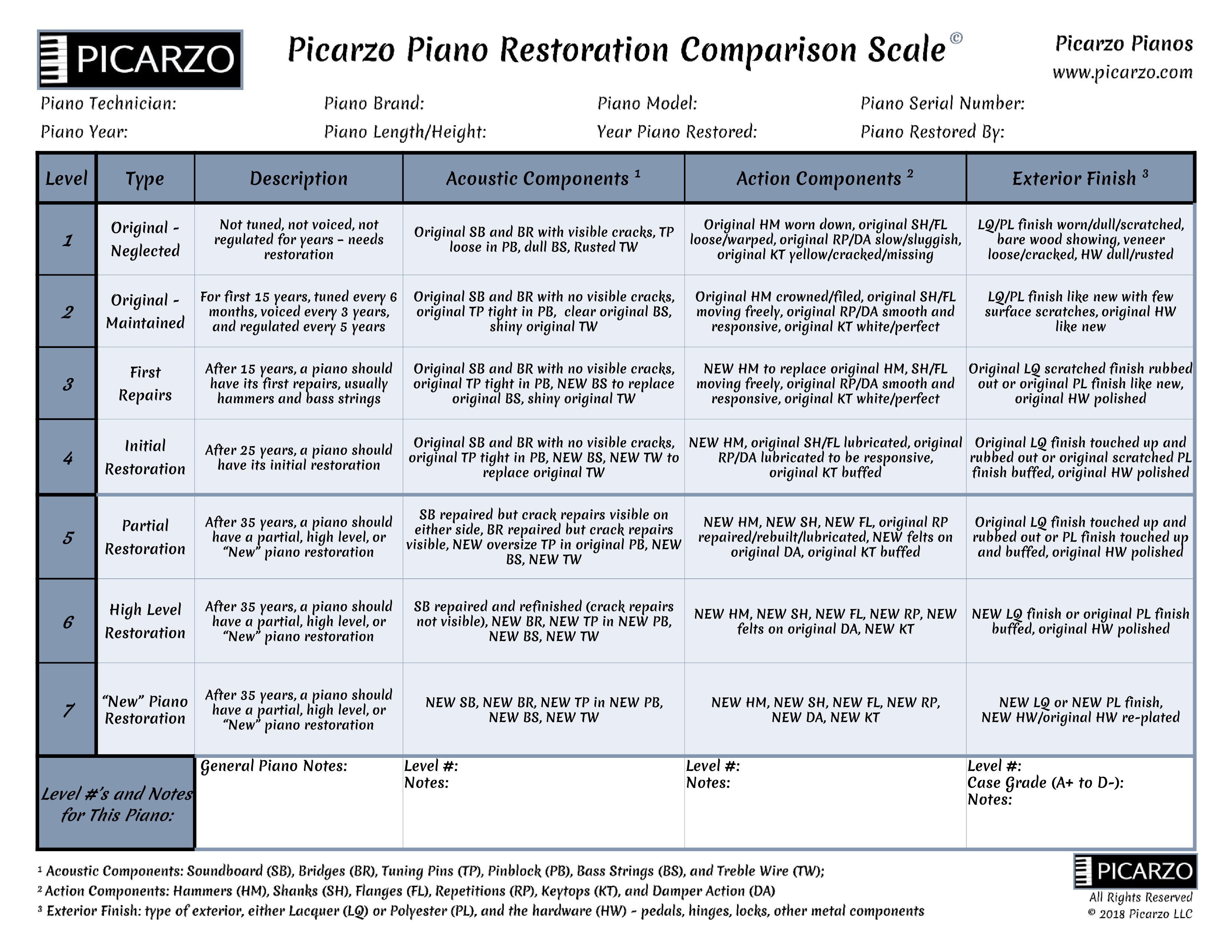
Early in our career, we were frustrated that every piano dealer used the word restored to describe their pianos, but would not say what was restored on the piano. We found that most dealers would patch up old soundboards with shims, change strings but use oversized tuning pins pounded into a 100 year old pin block, maybe replace the hammers while leaving the 100 year old shanks, flanges, and wippens in the principle action, and maybe add felt to the 100 year old damper action, and this would be their restored piano. Completely unacceptable. So we created a restoration scale that would identify exactly what was restored on our piano restorations (level 7 being the highest level in the action, acoustic, and exterior categories), and this could be used when comparing our restorations to other restored pianos offered by other dealers. The client could then decide whether the additional money for the Picarzo restoration was worth it to have a new soundboard, bridges, pin block, strings, tuning pins, hammers, shanks, flanges, wippens, and damper action in the Picarzo restoration. Here is the restoration scale in PDF form:
Link to PDF of Picarzo Piano Restoration Comparison Scale